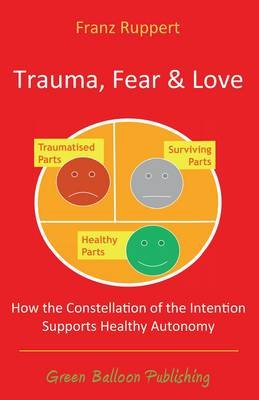
True Change with Sadiye Purslow
Psychotherapeutic Integrated-relational Counsellor MBACP (Accredited)

Trauma Therapy – The Intention Method

What is Trauma?

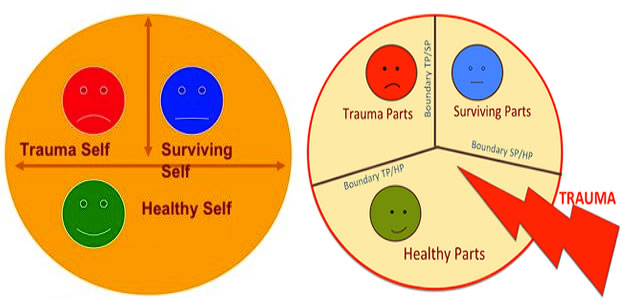
Primarily trauma is beyond ‘fight and flight’. It is a situation where the victim is completely helpless and overwhelmed by the forces at play. If one has the possibility of ‘fighting’ or ‘fleeing’ one is not completely helpless, and to describe this as trauma is not correct. The real trauma reaction is freeze (as in immobility, resignation, giving up) and fragmentation (as in dissociation and psychological splitting). One of the main reasons why the psyche fragments is to help us survive the experience by splitting off and keeping the unbearable feelings associated with the trauma, such as complete and utter helplessness, terror, panic, anxiety, rage, grief, and shock, away from conscious awareness. Instead we dissociate as a way in which to defend against and not feel the trauma feelings. This part, whose only function is to shield off and repress these feelings of trauma is called the “survival self”.

In relational trauma, which is most commonly what we are working with, it is a situation where the other person (the perpetrator) has all the power, and the victim, the traumatised person, has none. Therefore, any later situation in which a person experiences helplessness, and feels overpowered in any way by another is likely to unhelpfully re-stimulate the original trauma.

Feelings and memories of the trauma lay dormant in the unconscious and get re-triggered in certain situations which can lead to re-traumatisation. Therefore, until we can face and integrate the trauma directly we will be under its unconscious influence and be negatively impacted by it which shows up in our life as relationship difficulties, illness, depression, anxiety, further traumas and so on.

Over time the person’s survival strategies have to work harder and harder in order to manage and maintain the split in order to keep the unprocessed and unresolved trauma from breaking through into conscious awareness. So although the survival strategies were life-saving at the time, long-term they become limiting, debilitating and can actually end up destroying us as with the survival strategy of severe alcoholism for example, which serves as a kind of self-induced dissociation. The ultimate strategy used to avoid the feelings of trauma being suicide.

The good news however is that along with the unconscious traumatised part and the survival part that will go to any lengths to keep the trauma at bay, we also have a ‘healthy self’ which remains whole and untainted by the experiences and is constantly attempting to integrate the trauma experiences. Being in direct conflict with the survival self however, the healthy self can be hijacked and masked by this part making it difficult to maintain a connection with it. Constellations can therefore be a valuable tool in helping us to strengthen and sustain our connection with the healthy self.
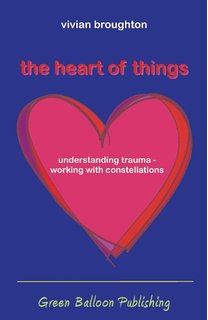
The Intention Method… (written by Vivian Broughton)

A Sentence of Intention
The work begins with the person who wants to explore an issue (I shall call the client), deciding on a sentence of intention. This may take some while, since the person may not have a clear idea of what they want. Eventually the person distils his intention into a sentence that he can write on a flipchart. This might be something like “I want to feel more at ease in myself” or “Why do I feel so anxious a lot of the time?” 

How this is stated and the topic is entirely up to the client. It is his intention, and can only be put into words by him. The therapist/facilitator listens to everything the client says but makes no suggestions and does not interfere in any way in how the intention is developed.

When the client develops his intention into a sentence he writes it on the board. This then forms the framework for the enquiry, and the way in which we keep to this framework is that the individual words of the sentence are all that is represented.

Beginning
The person then chooses someone from the group (or a floor marker in the private one-to-one session) to represent each word from the sentence. These ‘representatives’ resonate with the word they are representing, sharing their experience as best they can with the person doing the process. 
 
In this way each word will provide some information to the person about their intention, and the accumulated information can be very revealing as to the underlying dynamics and issues of the intention.
 
We know from recent developments in neuroscience that we are far more connected with each other than we think we are. In fact we are highly tuned to unconsciously reading and absorbing  the minute and subtle messages we are constantly giving out. Through the non-verbal parts of our brain, primarily the limbic brain system, we are in constant communication with each other, and in this kind of exploration we purposefully use this to access the unconscious. So the process becomes an exploration of the psyche of the person as it relates to the specific issue stated. 
 
Generally it is up to the client to decide when is enough. Sometimes the work just comes to a natural end and the client is satisfied; sometimes the client decides it is enough because such a great amount of information is shown that he decides he has seen enough for now. To go further might overwhelm him and thereby risk a re-traumatisation. Often what is seen has a powerful impact on the client, even to the extent of turning his whole perception of his life to date around. This sounds dramatic, but it is more often the case than not. On occasion the therapist may suggest to the client that it is enough, perhaps if she senses that more would be overwhelming for the client; however it is best if it is a clearly negotiated consent on the part of the client.

At the end those who have represented are dismissed and the work finishes.

Advantages for doing  trauma therapy
 
  • The Constellation of the Intention method enables you to get in touch with the unconscious parts of yourself and helps to resolve trauma. It does this by providing a way in which to clearly see and experience different parts of the self through the external representation of them
  • deeper awareness of your own types of survival strategies
  • strengthening of the healthy self
  • way in which to safely get in touch with the trauma
  • better connection between the different parts of the self thus enabling repressed and split off traumatized parts to be integrated
  • sense of inner peace as internal conflicts are gradually resolved
  • method in which inner trust can be developed
If you want further information, you can look at Vivian Broughton website https://www.vivianbroughton.com/ or alternatively buy her books or Franz Ruppert on Amazon. 

“All that we need to remember during our psychotrauma therapy is stored within us (in our body and our brain). It will show up, if we are prepared for it.”

Sadiye Purslow
Website design by Therapy Webgenie